Kanchan-Junga Expedition
Overview
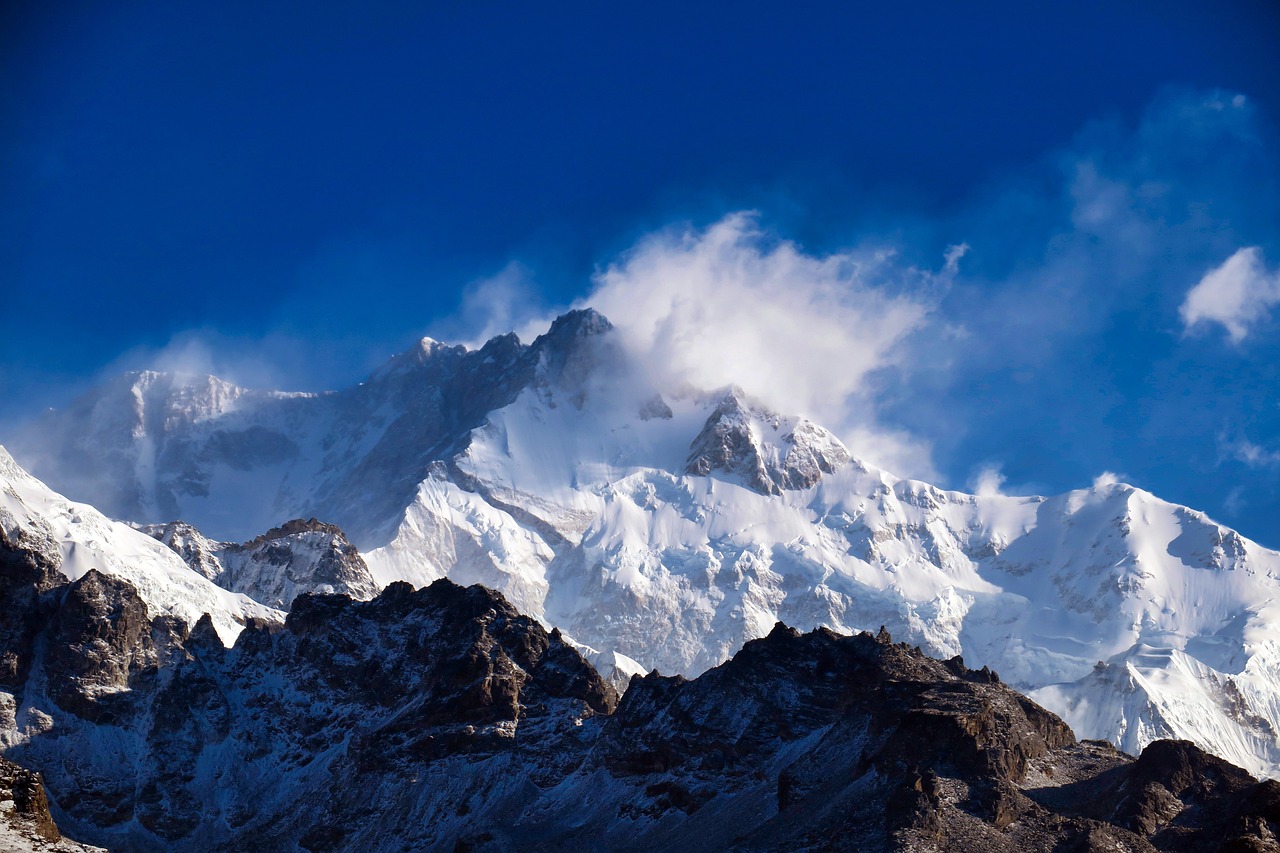
Mt. Kanchanjunga (8,586 m.) is another popular peak for an expedition in Nepal. It is the third-highest mountain in the world, situated at Sikkim (India) and Nepal border. Mt. Kangchenjunga is also popularly called Kangche Dzo-Nga, Kanchanjunga, and Kanchenjunga which means five treasures of the snow’. Five treasures of the snow mean five peaks.
Mt. Kanchan-Junga Expedition Trip Highlights
Mt. Kanchanjunga (8,586m): Third-highest peak globally, known as "Kangche Dzo-Nga" or "Five Treasures of the Snow."
Expedition Details: Popular peak for expeditions, climbed by a British team led by Charles Evans.
Geographical Location: Situated at the Sikkim (India) and Nepal border, with five peaks symbolizing the "Five Treasures."
Expedition Route: Trip starts with a flight to Suketar, passing through Taplejung, Mamankhe, Tamphudin, Chiang, and reaching Kanchenjunga base camp.
Return Journey: After exploring the base camp, the return route follows the same path back through Tamphudin, Mamankhe, and Suketar, concluding the expedition in Kathmandu.
Mt. Kanchan-Junga Expedition Description
Mt. Kanchanjunga (8,586 m.) is another popular peak for an expedition in Nepal. It is the third-highest mountain in the world, situated at Sikkim (India) and Nepal border. Mt. Kangchenjunga is also popularly called Kangche Dzo-Nga, Kanchanjunga, and Kanchenjunga which means five treasures of the snow’. Five treasures of the snow mean five peaks.
The highest peak of all the peaks is 8,586 m, which is known to be Mt. Kanchenjunga. This peak is said to have been climbed by a British expedition led by Charles Evans. The Kanchenjunga expedition trip begins with a short flight from Kathmandu to Suketar and then the trail continues through Taplejung, Mamankhe, Tamphudin, and Chiang and finally, the trail takes you to Kanchenjunga base camp and after making an excursion around, you will return back through the same route to Kathmandu.

Day by Day Itinerary:
Day 1 : Arrival TIA Kathmandu (1,350m) and transfer to hotel
Arrival at Tribhuvan International Airport, Nepal. And our representative From Unique Sherpa Trek & Expedition will be waiting for you with our company Banner Upon completing the visa formalities and collecting your luggage at the airport, kindly proceed to the exit of the arrival hall. Your trip leader will await you just outside the arrival hall and will escort you to your hotel in Kathmandu. Welcome drinks will be served and after you’ve refreshed, your leader will brief you about your trip in the lobby of your hotel in the evening. Get familiar with your surroundings by taking a walk down the street.
Day 2 : Sightseeing and prepare equipment for expedition
completion of required official procedures and taking a cultural tour of Kathmandu before the actual trekking will be the main agenda of this day. After breakfast, there will be a cultural tour to world heritage sites in Kathmandu which includes Kathmandu Durbar Square, Pashupatinath Temple, Swyambuhath, and Bouddhanath. During the afternoon, you will be meeting with other participants of the trekking program along with your guides at the NBT office for a pre-trip discussion. Overnight at hotel in Kathmandu.
Day 3 : Fly from Kathmandu to Biratnagar
You will fly from Kathmandu to Biratnagar. After arrival, check-in hotel. Overnight at hotel in Biratnagar
Day 4 : Fly from Biratnagar to Suketar
If you spent overnight at Biratnagar the previous day you will directly fly to Suketar this day and spend the night there. But, if you spent your night in Phidim you will be driving to Suketar. Either way, you spend overnight at Suketar. Overnight at lodge in Suketar
Day 5 : Trek from Suketar to Mitlung (922m/3,021ft)
We officially kick-start the day with a downhill walk to Mitlung. The trails throughout the lower sections of the Kanchenjunga region pass through fertile valleys with beautiful pastures and small villages. We then cross Hangdewa River and walk alongside the raging Tamor River. As we gradually head in a northerly direction the trail steepens after a few hours before a final descent of 350 meters on a muddy trail to Mitlung. We spend the night there. Overnight at lodge in Mitlung
Day 6 : Mitlung to Chiruwa (1,275m/4,168ft)
The trail ascends and descends steadily as we make our way towards the village of Sinwa. We continue trekking downhill until we reach Tawa. At Tawa, we ascend to some heights and cross the suspension bridge at This. We pass beautiful rural landscape along the way and reach Chirwa, a beautiful Limbu village with few lodges, tea shops, etc. We spend the night at Chirwa. Overnight at lodge in Chirwa
Day 7 : Chiruwa to Sukethum (1,577m/5,160ft)
The trek from Chirwa to Sukathum passes through varied landscapes such as cardamom fields and dense forests. We trek uphill for some time then descend to the lush green fields below and continue trekking along the Tamor River passing through a dense forest. It’s both uphill and downhill trek until crossing the Ghunsa River after which we reach Sukathum and spend the night there. Overnight at lodge in Sukathum
Day 8 : Sukethum to Amjilosa (2,308m/7,570ft)
Trekking from Sukathum to Amjilosa is challenging. After crossing the suspension bridge outside Sukathum we enter a dense forest, ascend the steep trail, descend and cross the river again. We also climb a gorge from the bottom pass by Solima village and descend again to the level of the river. All in all, this day’s trekking is rather tough. Therefore, it is advisable to be very careful especially while walking the trail that passes the gorge. We later follow a tricky trail that goes both uphill and downhill until reaching Amjilosa where we spend the night. Overnight at lodge in Amjilosa
Day 9 : mjilosa to Gyapla (2,730m/8,955ft)
We start trekking from the riverbank, pass through a dense forest of bamboo, fir, and rhododendrons eventually reaching a small stone house by the river. We then climb uphill crossing a few small bridges along the way. Here, we get to enjoy the company of stunning waterfalls that originate from the mountains. After yet another short uphill walk we reach the Tibetan settlement to Gyabla.
Day 10 : Gyapla to Ghunsa (3,590m/11,792ft)
We descend down the river and notice the valley as it slowly opens up before reaching Phale, a Tibetan refugee settlement where it is possible to purchase handicrafts and homemade rugs from locals. After purchasing a few souvenirs we travel through conifer and pine forest and reach the Sherpa village of Ghunsa where we spend the night. This place is known for its hydroelectricity plant and the fact that more than 20 prominent conservationists met a tragic end in a helicopter crash. Overnight at lodge in Ghunsa
Day 11 : Acclimatization at over Ghunsa
We take care to spend time acclimatizing around Ghunsa before continuing our next day’s trek. We recommend you to stay active even on a rest day as it is better than being idle while on a trekking journey. Therefore, we take a short hike towards the Laspsan La monastery through the lush green forest. Come back to Ghunsa by afternoon and relax.
Day 12 : Ghunsa to Khambachen (4,050m/13,285ft)
From Ghunsa we trek further north along the river bank which presents us with magnificent mountain scenery. We pass through meadows full of beautiful wildflowers, rhododendron, and pine forests. We cross a bridge at Rampuk Kharka, continue past the waterfall, and cross the tricky section of the landslide. After crossing the landslide area we begin to see the spectacular view of Mt. Jannu. Further exploring and tackling the tricky mountain trail we finally arrive at Kambachen and spend the night.
Day 13 : Acclimatization day at Khambachen
We take yet another day for acclimatization at Kambachen which is reserved to accommodate participants in high altitudes and also to observe if anybody in the group has any symptoms of altitude sickness. The overall idea for this day is to relax- take a bath and/or explore the Nuphchu Khola Valley area. We spend yet another night at Kambachen.
Day 14 : Khambachen to Lhonak (4,780m/15,678ft)
Today will be another challenging day and an early start is needed. We trek through rocky fields and large boulders on the hillside along the riverbank and arrive at a waterfall. We then cross a bridge to Ramtang monastery. We then come across a landslide section which we must pass through at a steady pace before descending to the river and finally arriving at Lhonak. Overnight at lodge in Lhonak
Day 15-39 : Expedition periods for Mt. Kanchan-Janga
Expedition day starts from day 15 to 39 day
Day 40 : Trek back to Kambachen (4,050 m/13,284 ft) 6-7 hrs
We retrace our path to Lhonak and continue down the valley to Ramtang Monastery. The return journey offers a different perspective of the mountains Kanchenjunga, Table Shikhar, Gimmigela, and Mera Peak among others. Due to the descending nature of this trek, we will reach Kambachen by evening and spend the night there.
Day 41 : Kambachen to Ghunsa (3,595 m/11,792 ft) 3-4 hrs
It’s essentially the reverse of our Day 12 trek. We descend to Ghunsa from Kambachen which means that we get to enjoy the beautiful forests along with a backdrop of impressive mountain scenery. Overnight at Ghunsa
Day 42 : Ghunsa to Sele Le (4,290 m/14,071 ft) 6-7 hrs
It’s a steep trek upward from Ghunsa to Sele-Le. Upon reaching Sele Le we climb through a dense forest of moss, rhododendron, and juniper. Lunch will be served in an appropriate place with the availability of water. We spend the night in Sele Le.
Day 43 : Sele Le to Cheram (3,870 m/12,694 ft) 6-7 hrs
We do an uphill trek and enjoy the mesmerizing south side view of Jannu Himal and Makalu (the world's 6th highest mountain). Today is a strenuous trekking day as we cross several passes- Sinon La, Mirgin La, and Sinelapche Bhanjyang. We then make a steep descend to Cheram and spend the night there.
Day 44 : Cheram to Ramche (4,580 m/15,022 ft) and return back to Cheram, 4-5 hrs
We ascend past the snout of the Yalung Glacier and walk alongside the Simbuwa Khola, pass through Lapsang village, and reach Ramche. While there, we walk further up the valley or ascend a ridge for a tremendous view of blue sheep. We then follow the stream before climbing on the moraine top until confronted by Kanchenjunga’s southern face. We walk further ahead for a glimpse of the Jannu Himal. We can even consider continuing to Oktang Monastery. Descend and spend the night at Cheram.
Day 45 : Cheram to Tortong (2,995 m/9,824 ft) 5-6 hrs
As we descend to Tortong we first encounter two trails. One trail is the one we took while descending down from Sele Le. However, we ignore this route and descend further down to the trail alongside the Simbuwa Khola. We enjoy the lush rhododendron forest along the way.
Day 46 : Tortong to Yamphudin (2,080 m/6,822 ft) 6-7 hrs
While descending from Tortong to Yamphudin we pass through Lasiya Bhanjyang which involves walking up through trees and areas of landslides. The terrain changes after every monsoon but by the middle of October, it should be stable with a route through. Walking further down we reach the village of Yamphudin, a village inhabited by Sherpas, Limbus, and Rais.
Day 47 : Yamphudin to Yangpang (1,007 m/3,304 ft) 6-7 hrs
We descend from Yamphudin, cross the bridge at Samekham, and continue following the Kabeli Khola. We pass through Mamankhe which houses the Limbu Museum and Cultural Center. We then cross the bridge over Khaksewa Khola and ascend through the cardamom forest, pass by a few villages, and descend further down to Yangpang. Overnight at Yangpang
Day 48 : Yangpang to Thorpu (1,500 m/4,290 ft) 5-6 hrs
Instead of going back to Taplejung, we descend down to Thorpe. By opting for Thorpu we will not only be saving time but will also get to enjoy the landscape of a different route. While descending to Thorpu we pass through some really beautiful terraced villages, where the people are very interested to see you. We spend the night in Thorpu and enjoy the hospitality of the villagers.
Day 49 : Thorpu to Birtamod (300 m/ 984 ft) 5-6 hrs
We are most likely to drive from Thorpu to Birtamod which is a lively Terai town in Eastern Nepal. Along the way, you will notice the climate getting warmer with a landscape that is different from the mountains and the hills. The town boasts a number of good accommodation facilities, therefore, we spend the night in Birtamod.
Day 50 : Drive from Birtamod to Bhadrapur then drive to Kathmandu
The drive to Bhadrapur from Birtamod is only of short distance. We drive back to Kathmandu. Upon arriving in Kathmandu you can take a rest and relax throughout the day in your hotel or if you are interested in taking souvenirs for your loved ones, you can shop around the tourist area of Thamel. Nepal Beginner Travels and Treks Expedition will be hosting a fantastic celebration dinner for the successful completion of your Kanchenjunga Circuit Trekking.
Day 51 : Farewell & Departure!
Your journey comes to an end today. There is nothing to do but trade emails with your travel companions and organize your photos. A representative of Nepal Beginner Treks will take you to the airport approximately 3 hours from your scheduled flight. On your way home you will have plenty of time to plan your next adventure in the wonderful country of Nepal.

What's included:
- Airport pick-up and Transportation.
- 3-Night Hotel at Kathmandu (5 Start) Hotel.
- Domestic flight tickets (Kathmandu – Bhadrapur – Kathmandu) and airport departure taxes.
- (100% Waterproof) Duffle bag to keep your personal belongings and things to be carried by the porter.
- 3 Time Meals with Tea/Coffee During Trek.
- Professional Climbing Guide, Personal guide, and Potters (Size of the Groups) During the Trek.
- Climbing Permit, "TIMS", National Parks Entry Fee.
- All wages and medical, Insurance, for the Guide and potters.
- First-aid Medical Kits for the Group and Staff.
- Kitchen tents, Sleeping Tents, Dinning Tents, and Toilet Tents.
- All Kinds of Food During Climbing Duration.
- Unique Sherpa trek & Expedition Appreciation Certificate after the successful Expedition.
- Fare-Well dinner in Kathmandu Before Departure
What's excluded
- Nepal entry visa fee.
- Lunch and dinner in Kathmandu and also in case of early return than the scheduled itinerary.
- Extra baggage check-in during the flight (Kathmandu-Lukla-Kathmandu) if more than 15 KG, extra, can pay directly to the airline.
- Any kind of meal During Your Stay in Kathmandu (Except Farewell Dinner).
- Rescue, Medicine, Medical Test, Repatriation, Hospitalization Expenses for Climbs.
- Any Internet, Hot shower, Drinking Water, Alcohol, cold Drinks, Laundry.
- Additional costs suffered due to causes beyond our control, such as natural disasters, weather conditions, itinerary modifications due to safety concerns, emergency evacuation, changes in government policies, strikes, and so forth.
- Insurance for Clients
- International flight Tickets.
- Clothing, Packing Items or Bags, Personal, Medical Kits, and Personal Climbing gear.
- Climbing Summit Bonus.
- Normally 15% Tips for all Staff.
- any other items, not Included in the Above (Cost Includes) Section

Additional information:
Expedition Logistics and Support: Organizing a successful Kanchenjunga Expedition requires meticulous planning of logistics and support services. This includes arranging transportation to the trailhead, coordinating porters to carry equipment and supplies, organizing food and fuel resupplies at high camps, and ensuring communication systems are in place for emergencies.
High-Altitude Medical Training: Prior to embarking on the Kanchenjunga Expedition, climbers are strongly advised to undergo high-altitude medical training. This training covers essential topics such as recognizing symptoms of altitude sickness, administering medication such as Diamox, and understanding how to respond to medical emergencies at high altitude.
Fixed Rope and Ice Axe Technique: Climbers should be proficient in fixed rope and ice axe techniques for ascending and descending steep snow and ice slopes. Training in these techniques, including proper footwork, self-arrest, and using ascenders and descenders, is essential for safety and efficiency during the climb.
Weather Patterns and Climbing Strategy: Understanding weather patterns and developing a sound climbing strategy are crucial for a successful Kanchenjunga Expedition. Climbers should monitor weather forecasts, identify optimal summit windows, and adjust their itinerary and acclimatization schedule accordingly to maximize safety and summit chances.
Team Dynamics and Communication: Effective team dynamics and communication are essential for a successful summit bid on Mount Kanchenjunga. Climbers should establish clear roles and responsibilities within the team, communicate openly and transparently, and work together to make collective decisions that prioritize safety and well-being.
Environmental Conservation and Leave No Trace: Practicing environmental conservation and Leave No Trace principles is essential to minimize the impact of the Kanchenjunga Expedition on the fragile mountain ecosystem. Climbers should adhere to guidelines for waste management, minimize use of single-use plastics, and respect local customs and cultural sites.
Satellite Communication and Emergency Response: Carrying satellite communication devices such as satellite phones or GPS trackers is recommended for emergency communication during the Kanchenjunga Expedition. Climbers should have a comprehensive emergency response plan in place, including protocols for evacuation, medical treatment, and communication with rescue services.
Cultural Sensitivity and Local Engagement: Climbers should approach the Kanchenjunga Expedition with cultural sensitivity and a respectful attitude towards local communities. Engaging with local people, learning about their customs and traditions, and supporting local businesses and initiatives can enrich the overall climbing experience and foster positive relationships.
Post-Expedition Reflection and Learning: After completing the Kanchenjunga Expedition, climbers should take time to reflect on their experience and share insights and lessons learned with others. This may include documenting the expedition through writing, photography, or video, and participating in debrief sessions to evaluate strengths, weaknesses, and areas for improvement.
Expedition Safety and Risk Management: Prioritizing expedition safety and risk management is paramount throughout the Kanchenjunga Expedition. This includes conducting thorough risk assessments, identifying potential hazards, implementing mitigation measures, and maintaining open lines of communication within the team to address any safety concerns promptly.
Languages
More Dates
Available Dates
Kanchenjunga summit expedition