
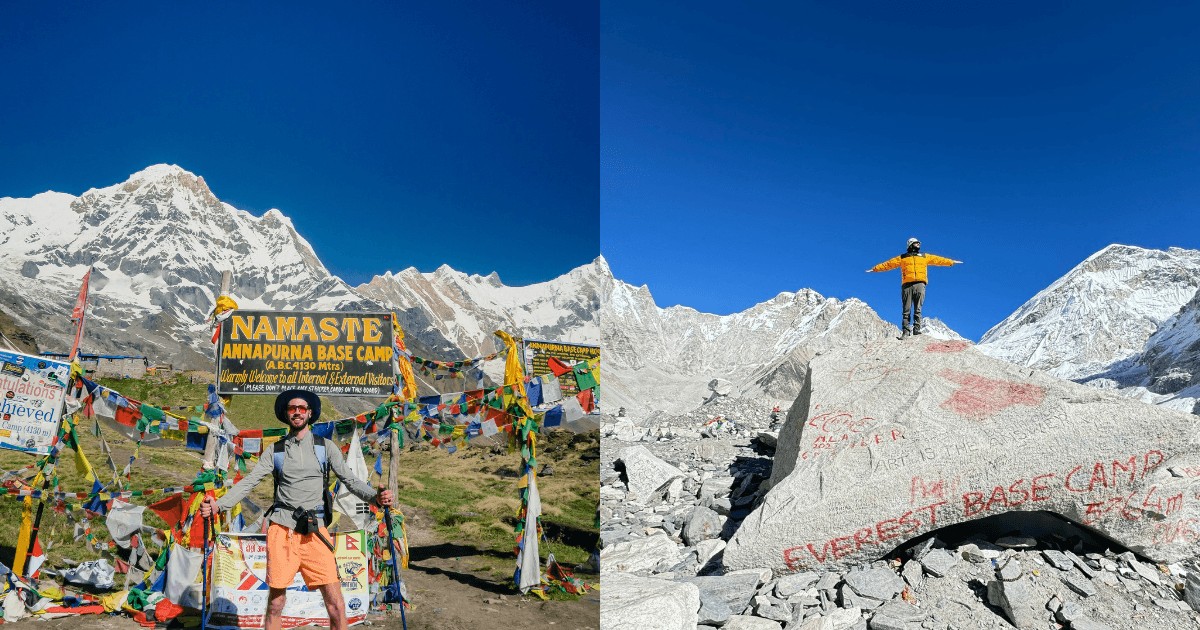
If you’re planning on your first big Himalayan adventure, chances are you’re stuck in the same dilemma as thousands of other trekkers: Annapurna Circuit or Everest Base Camp? Both are bucket list hikes. Both give you snow peaks, Sherpa and Gurung culture, and a real sense of achievement.” But they are very different.
In this guide, we will compare the Annapurna Circuit and the Everest Base Camp in terms of difficulty, scenery, altitude, culture, logistics, and cost, to help you decide which trek is best for your fitness, schedule, and travel style.
Annapurna Circuit vs Everest Base Camp: Quick Comparison
There are numerous similarities between the two trekking adventures. First of all, they both include teahouse routes that take around two weeks to complete. They also both include ascents to more than 5,300 m altitude and are best trekked in either spring or fall. The Annapurna Circuit includes a trek around the central part of Nepal and passes Thorong La Pass at an elevation of 5,416m, and that can be done in ten to fourteen days, depending on road conditions. The Everest Base Camp trek is more of an out-and-back style kind of trek situated in the east of Nepal through the Khumbu region of Everest, requiring fourteen days as well in total to get to Base Camp (5,364 m) and the Kala Patthar Viewpoint (5,545 m).
However, the landscapes, cultures, and logistics are vastly different. The Annapurna Circuit covers quite diverse landscapes that evolve from subtropical forests and terraces to high-altitude desert with indigenous communities belonging to the Gurung, Thakali, and Manangi ethnic groups, and starting with a lengthy drive. The EBC trek is rather similar. It goes through higher elevation glacial valleys with Sherpa villages and monasteries, and usually starts with a flight to Lukla.
Annapurna Circuit Overview
The trek of the Annapurna Circuit encircles the Annapurna Mountain range. It moves upward from the low altitude settlements along the rice fields through the Marsyangdi river valley, goes past Manang and surmounts the Thorung La Pass, moves on to the Kali Gandaki river canyon, and ends at Muktinath and Jomsom.
The specialty of this trek is in its diversity. In one journey, you will pass through tropical forests, pine and rhododendron forests, dry Tibetan-type landscapes, and dry desert-like gorges and ravines.
The Annapurna Circuit today: roads have changed the route
In the last ten years, road development has affected trekking in the valleys of Marsyangdi and Kali Gandaki. Many have opted to take a jeep ride to Besisahar or even further ahead of their trekking journey rather than covering each part of the trek on foot, up until their destination at Muktinath or Jomsom. While this has allowed for a shorter trek for many travelers, it does mean that they will still cover the important sections at altitude by foot. However, ensure to verify up-to-date road and trekking information with a Provider before planning.
Everest Base Camp Overview
The trek into Everest Base Camp takes you to the Khumbu region, the land of the Sherpas and some of the highest peaks in the world. The majority of trekkers land in Lukla and trek the Dudh Koshi valley crossing, Phakding, Namche, Tengboche, and Dingboche before arriving at Gorak Shep and going to Everest Base Camp at 5364 m. The other option is to climb Kala Patthar to see Mount Everest, which is not visible from the Base Camp.
The feeling of being in EBC is about the ambience and size of the place: suspension bridges adorned with prayer flags, monasteries, yak caravans, as well as spectacular peaks such as Ama Dablam, Lhotse, Nuptse, and Pumori.
A note on Lukla flights
In the high season, flights for Lukla tend to fly from Ramechhap (Manthali) instead of Kathmandu, which will result in the need for transfers lasting hours in the morning. Because of the high likelihood of weather-related delays, it is advisable to include additional days to the planned itinerary.
Annapurna Circuit vs Everest Base Camp Difficulty
Both treks are demanding, and neither requires technical climbing skills. The real challenge is altitude, daily walking time, and weather.
How difficult is the Annapurna Circuit?
The Annapurna Circuit is described as being moderate to difficult. You have to walk five to seven hours every day while going either uphill or downhill. The most challenging day is the crossing of the Thorong La Pass which is 5,416 m high. It is necessary to leave Thorong Phedi or High Camp before sunrise, and this part of the trek may take from seven to ten hours, considering the long descent to Muktinath. Extreme weather and altitude can make it hard, even for skilled walkers.
On the bright side, the Annapurna Circuit climbs certain peaks gradually when you are in Manang valley, and the acclimatization day in Manang (in addition to some with optional hikes) provides one’s body a chance to adapt as well.
How difficult is the Everest Base Camp trek?
The EBC Trek presents a moderate to difficult level of challenge. The standard distance per day is manageable; however, trekkers will be dealing with many days in the high Himalayan region of 3,500 meters and more. The trail will mostly require going uphill and downhill, around Namche Bazaar to Tengboche. Nights spent on the elevation can be somewhat of a challenge with the cold and difficulty sleeping.
Worry not, since the structure of the trek contains acclimatization days at Namche Bazaar and Dingboche, which, as a result, helps to make the trek feasible for healthy and prepared first-timers.
Which is harder?
It depends on what you find harder:
In the course of the Annapurna Circuit, the challenging nature is limited to one extremely demanding day spent at Thorong La. The remaining parts of the trail feature significantly easier and less challenging ups and downs, as well as, lower altitude of sleep. The Everest trek, on the other hand, is characterized by continuous high elevation: one spends more time at high altitude, which leads to slow acclimatization and thus makes the entire trek more exhausting.
The two treks are of similar difficulty in general for an average person. The threat of altitude sickness is present in both cases. Therefore, the behavior during the trek becomes much more vital than physical shape.
Annapurna Circuit vs Everest Base Camp for Beginners
When comparing the Annapurna Circuit to the Everest Base Camp trek for novices, the truthful conclusion is that both options are plausible for a well-prepared first-time trekker with an average fitness level, but neither trek would fall under the category of “easy walks.”
If you are a beginner and want to try the Everest Base Camp trek, you will appreciate the well-defined and safe destinations on this trek, which come with lodging, acclimatization days, and experienced guides and porters. If you want more options and enjoy longer days spent hiking, the Annapurna Circuit is your choice.
If you are just starting out with trekking, you may want to think about going on a shorter route. For novices, Annapurna Base Camp and Poon Hill treks are the best options one may choose, while Langtang Valley and Gokyo Lakes are great follow-up treks after you have gained more experience in trekking.
Annapurna Circuit vs Everest Base Camp Scenery
While both treks are among the best in Nepal, the landscapes are notably different.
Landscape of Annapurna Circuit trek: The trek starts with a scenic walk past waterfalls, terraced agriculture, and bamboo forests in the lower valley, with wonderful vistas of Annapurna 2, 3, and 4, Gangapurna, Tilicho Peak, and Dhaulagiri. The landscape looks quite different at higher altitudes as we enter the arid terrain of Manang. We cross Thorong La pass with 360-degree views, followed by the descent into the Kali Gandaki gorge, which is among the world’s deepest gorges.
Landscape of Everest Base Camp trek: This trek involves the crossing of numerous suspension bridges and forests, and we can get closer views of Ama Dablam, Lhotse, Nuptse, and Pumori. The Khumbu Glacier, the biggest glacier in the country, is also there. The real highlight of this trek is the beautiful sunrise seen from Kala Patthar.
In summary, if one is looking for diverse landscapes, the Annapurna Circuit is the better option. However, if there is a desire for large mountains and beauty, EBC is definitely better.
Culture and Experience
The Annapurna Circuit takes you through various communities from Hinduism and Buddhism, such as Gurung, Thakali, and Manangi communities, and ends in the apple-producing and culture-rich regions of Marpha and Jomsom. The cultural transition from the more populated areas to the highland regions is truly fascinating.
On the Everest trail, you will experience the essence of Sherpa and Tibetan Buddhism. You will witness life at various monasteries, learn about expeditions, and mingle with climbers on their way to the highest mountains. The trail is quite busy during the peak season, but the atmosphere is amazing.
Crowds, Accommodation, and Logistics
You will find that the number of travelers along the way may tend to be larger on the EBC than in the Annapurna Circuit, especially during the months of October and April. The latter seems bigger and less “wild” than the former, which also means you don’t get lost if you feel out of your element sometimes.
Both these treks fall under ‘teahouse treks,’ which means they offer no frills lodging and food, shared toilets at high points, and better lodgings and foods at low ones. So, there’s little difference between them here apart from the above-mentioned reasons. Also, both require certain permits, such as the Annapurna Conservation Area Permit (for Circuit), Sagarmatha National Park, and the local Municipality permit (EBC).
Please note that the exact requirement or fee might change, hence please confirm via contacting your trekking Provider or Nepal tourism sources before heading off. Transportation-wise, one requires driving for many hours to reach the Annapurna Circuit, whereas the starting point of the EBC Trek involves flying just for short distances to Lukla, depending upon the weather condition.
Cost: Which Trek Is Cheaper?
While the Annapurna circuit tends to be just a bit less expensive than Everest base camp (mainly because of the additional cost of including a Lukla flight for EBC), there are quite a few variations that will affect price.
You can see a huge difference depending on whether or not you’re hiring a guide/porter, traveling in peak season, what kind of comfort level you have when it comes to your lodges, and other variables.
Try to get some quotes from 2-3 reputed Providers and look for things you may or may not include with each package.
Best Time to Trek
The best times for either trek would typically be during the autumn (September-November), when you’ll enjoy clear skies and nice weather. This period also sees the highest volume of trekkers, while spring (March-May) is another prime time with blooming rhododendrons and milder temperatures—though views may be hazier at this time.
Though some people do these treks during winter months, that’s only really feasible if you’re up for very cold temps and high mountain passes like the Thorong La can get snowed over. As far as the rainy season goes, June through August brings torrential downpours and swarms of leeches to many lower portions of the Circuit, although the Manang/Mustang area is somewhat protected due to being located within a “rainshadow”.
Altitude Sickness: Staying Safe on Either Trek
Whichever trek you choose, take altitude seriously:
- Go slowly. Do not rush your itinerary or skip acclimatization days.
- Hydrate well and eat regularly, even if your appetite is low.
- Know the symptoms of acute mountain sickness: headache, nausea, dizziness, poor sleep, and fatigue.
- Descend if symptoms worsen. Never ascend with worsening symptoms.
- Talk to your doctor before you travel, and get good travel insurance that covers trekking at altitude and helicopter evacuation.
Annapurna Circuit or Everest Base Camp: Which Is Better for You?
Ultimately, there isn’t one answer to ‘which is better between the Annapurna Circuit and the Everest Base Camp?’ That’s because each trail caters to different things.
If you prioritize diversity of landscape or culture, the thrill of crossing a high pass, and the flexibility or reward of looping around instead of retracing your steps – pick the Annapurna Circuit.
Alternatively, if you’d like to stand at the feet of the world’s highest mountain and hit the trail for a classic, well-supported teahouse trek that’s easy enough for most travelers (though definitely harder than an average walk), then the Everest Base Camp Trek should be considered.
The Circuit is also suitable if you’re fine with long drives during the itinerary, are okay with skipping certain roads during the tour, or looking to keep costs down.
You might also consider going this way if you can manage being flexible about where you sleep during your trip.
On the other hand, EBC will appeal more directly to those who love visiting cultural landmarks like monasteries, learn about local cultures like the Sherpas, want to see lots of mountains and their rich mountaineering history, need some time off on the trail to acclimatize, don’t mind the potential crowds in peak season, and enjoy doing everything back-to-back.
If you are still confused between the Annapurna vs Everest Trek – which one should you go for? Try answering this one question first – Are you going for the icon of all mountains (Everest) and its basecamp, or do you just love diverse landscapes with a dramatic pass?
Well, if you love the iconic summit of all the peaks, then you can take the EBC trek.
And if you’re looking for an adventurous trip with diverse landscapes and a dramatic pass, then we suggest you pick the Annapurna circuit!
Frequently Asked Questions
Is the Annapurna Circuit harder than Everest Base Camp?
They are similar overall. The Annapurna Circuit has one extremely tough day crossing Thorong La, while EBC involves longer stretches at high altitude. Good acclimatization matters more than which trek you pick.
Which is the best trek in Nepal for beginners?
For complete beginners, the Poon Hill and Annapurna Base Camp treks are popular and manageable. Among the big classics, Everest Base Camp with proper acclimatization is a common first high-altitude trek for fit beginners.
Which is the best Himalayan trek in Nepal?
It is subjective. The Annapurna Circuit, Everest Base Camp, Manaslu Circuit, Langtang, and Gokyo Lakes are all contenders for the best treks in Nepal. Annapurna and Everest are the two most famous.
How many days do I need for each trek?
Plan around 10 to 14 days for the Annapurna Circuit (depending on where you start and finish) and around 12 to 14 days for Everest Base Camp, plus spare days for flight delays and rest.
Do I need a guide?
Independent trekking is possible on both, but many trekkers hire a licensed guide or porter for safety, navigation, altitude monitoring, and to support local jobs. Check current regulations, as rules about guides can change.
Can I do both treks?
Absolutely. Many trekkers do one in spring and one in autumn, or combine them across different trips.
Final Thoughts
With the choice between the Annapurna Circuit and Everest Base Camp, there is no mistake to make. The Annapurna Circuit provides an unmatched variety with an exciting high-pass crossing. Everest Base Camp, on the other hand, gives you the legend, the Sherpa culture, and the sense of awe that comes from standing in the shadow of the world's highest mountains.
Choose the trek based on your level of fitness and availability of time to enjoy the mountainous terrain and your desired experiences.
Train for trekking appropriately as you are likely to hike at high altitudes where altitude sickness might happen if not taken care of properly. Book with a reputable local Provider who can take good care of your overall needs while trekking.
No matter which route you pick, Nepal has a unique way to leave unforgettable memories into your life long after you’re off the trails!
Ready to plan your trek? Contact Actiontrails to get a tailored itinerary, current permit details, and up-to-date trail conditions for the Annapurna Circuit or Everest Base Camp