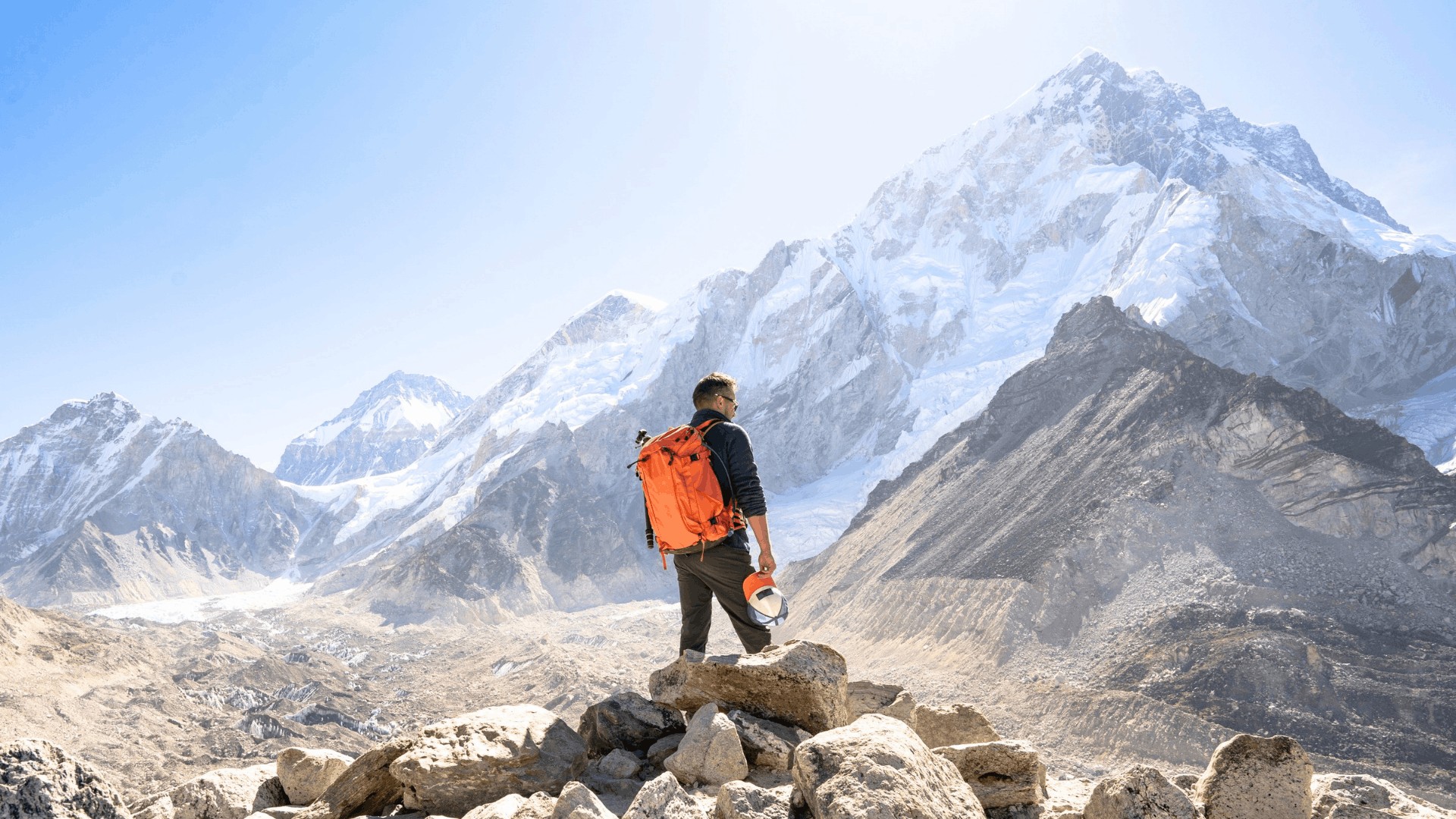
There is a kind of quiet that wraps around you on the trail into the Khumbu. It comes somewhere between the prayer flags at Namche and the moraine fields above Lobuche. That is when it hits you. No photo, no video, no movie clip could ever show you what these mountains truly look like. The scale is overwhelming. The Everest Base Camp trek remains one of the most famous teahouse treks in the world. It lasts between 12 and 16 days. You walk through Sherpa villages, past forests, across swaying suspension bridges. Then the trees stop. The rock opens up. You climb into the Himalayas. At the end, you stand at 5,364 meters in the shadow of the tallest mountain on Earth.
If you have ever typed "EBC trek cost 2026" or "how hard is the Everest Base Camp trek" into a search bar at two in the morning while your travel plans sit unfinished in another tab, then this guide is for you. It answers those questions clearly. It gives you numbers. It explains the rules and regulations that changed this year. Not just the usual advice you see online. This guide tells you what actually matters now.
How Much Does the Everest Base Camp Trek Cost in 2026
Ask five trekking companies what the trip costs. You will get five different prices, and none of them are being dishonest. The cost of this trek is not one number. It is like a range that changes completely depending on the level of comfort and help you decide to pay for. People who go with a guide but do not use a porter and stay in the simplest teahouses can expect to spend between $1,000 and $1,500. This amount still has to include a guide because Nepal no longer allows foreigners to walk this path without one. Most new trekkers choose the guided package. This package costs around $1,400 to $2,800. It usually includes a guide, a porter to carry the heavy items, teahouse stays each night, most of the meals, the domestic flights to and from Lukla, and all the permits needed during the trip. At the top end sit the premium and luxury packages, often priced from $3,000 up past $5,500. They offer groups, more experienced guides, better lodges with better food, and sometimes a helicopter ride back from Gorak Shep instead of walking all the way down. If you want one number to use when planning your budget, go for between $1,800 and $2,200 for a fully supported 14-day trek with a good safety buffer.
That headline price generally covers the two required permits for the region, which together run roughly $50 to $60, along with the round-trip Lukla flights, which during the busiest weeks of spring and autumn are often rerouted through Ramechhap instead of Kathmandu's main airport. It also covers your teahouse rooms, three meals a day while you are on the trail, and the wages of your guide, who by Nepali law must be licensed and employed through a registered trekking agency.
What tends to catch first-time trekkers off guard is everything that sits just outside that headline number. Wi-Fi and device charging cost $2 to $5 each time you use them at a teahouse, and that price climbs the higher you go. Hot showers become a paid luxury above Namche, sometimes costing $5 to $6 a rinse. Bottled water gets more expensive with every day of walking, which is reason enough to carry a filter or purification tablets instead. Travel insurance with high altitude evacuation coverage is not optional in any real sense, and it is worth budgeting $80 to $150 for a policy that will actually pay out if you need a helicopter off the mountain. And then there are tips for your guide and porter, which by long-standing custom on this trail should add up to something in the range of $200 to $300 by the end of the trip.
Do You Need a Guide for Everest Base Camp in 2026
Yes, and this is not a suggestion so much as the law. Since April of 2023, Nepal has required every foreign trekker on its regulated trails, including the entire Khumbu region that leads to Everest Base Camp, to hire a licensed guide through a government-registered trekking agency. Fully independent, unguided trekking is no longer a legal option on this route, and the rule is enforced at checkpoints such as the one at Monjo, where solo travelers without proper documentation have been turned back. In March of 2026, Nepal did loosen a related rule for its restricted areas, places like Upper Mustang, by removing the old requirement that permits be issued only to groups of two or more. It is worth being precise here, because that change applies only to those separate restricted zones and does nothing to alter the guide requirement for Everest Base Camp itself, which remains firmly in place. Expect to pay your guide somewhere between $25 and $35 a day, on top of covering their food and lodging as their employer for the duration of the trek.
Everest Base Camp Trek Itinerary, Day by Day
Most operators build their trips around a 12 to 14-day framework that includes two dedicated acclimatization days, since rushing the altitude gain is the single most common reason trekkers fail to reach base camp. A typical 13-day version begins with a short, often dramatic flight from Kathmandu into Lukla's mountainside airstrip, followed by an easy first afternoon of walking down to Phakding. The second day brings the long, steady climb up to Namche Bazaar, the unofficial capital of the Sherpa homeland, and the first place most trekkers really feel the altitude. A full rest day follows in Namche, usually filled with a short acclimatization hike up toward the Everest View Hotel rather than actual rest.
From there, the trail goes higher, passing through Tengboche. This is where the famous monastery in the region stands. On a morning, you can see Everest directly from here. That view is one of the best on the trek. The path keeps going to Dingboche. A second acclimatization day is scheduled there. It helps the body adjust before the air becomes thinner and thinner.
Next comes the push toward Lobuche. The terrain changes. It becomes harsher. Rocks dominate the landscape. Trees are fewer. People are fewer. The sense of isolation grows.
The day after that is the one everyone dreams of since they booked the trip. It’s the walk from Lobuche to Gorak Shep. Then a short but intense walk across the Khumbu Glaciers, moraine. That takes you to Everest Base Camp at 5,364 meters. Afterward, you return to Gorak Shep to rest.
Many say the next morning is the heart of the whole journey. It starts before dawn. Headlamps glow in the dark. You climb Kala Patthar to 5,545 meters. The climb is steep. The reward is worth it. You watch the sunrise hit Everest’s summit. It’s the place on the mountain to catch the light. That moment is unforgettable.
The descent back to Lukla takes three to four days. You retrace the path through Pheriche and Namche. The journey back is slower. It’s more about reflection.
It’s important to build in at least one buffer day near the end. Why? Because Lukla’s flights are highly unreliable. Weather delays are common. The airport is small. The conditions change quickly. A buffer day gives you room to breathe. It gives you time to wait. It gives you peace of mind.
How Difficult Is the Everest Base Camp Trek
This trek does not require ropes, crampons, or advanced climbing skills, which is exactly why many people without mountaineering experience try to trek each year. That does not mean the trek is easy. Three things make trek truly hard. The first is altitude because trek participants will sleep above 4,000 meters for nights and eventually cross above 5,300 meters, and altitude sickness is the main reason trek participants stop, regardless of how fit they are. The second is terrain. The large number of walking hours usually 4 to 7 hours a day over rocky uneven ground with steep repeated climbs and descents that add up over nearly two weeks. The third is cold because nighttime temperatures at elevations drop well below freezing even in warmer trekking seasons, and teahouses higher in the valley are not heated like lower ones. What actually brings trek participants to base camp safely is cardiovascular fitness paired with patience and a slow deliberate pace, rather, than raw strength or prior high‑altitude experience.
Best Time to Trek Everest Base Camp
Spring, which lasts from March to May, brings days and a new kind of excitement because climbing teams begin their own push toward the summit, and the trail buzzes with a different energy. Autumn, which lasts from September to November, is generally seen as the time for the trek because the weather is steady and the mountain views are the clearest and most reliable of the year, which is also why many people come during Autumn. Winter, which covers December to February, and the summer monsoon months from June to August both give a quieter, option for trekkers who are ready to face real trade-offs. These trade-offs can be cold and snow on the ground during Winter or constant rain, leeches on lower trails, and a higher chance of flight delays during the monsoon.
How to Prepare for the Trek
Physical preparation must start at least eight to twelve weeks before you leave. Physical preparation should include cardiovascular training like hiking, climbing stairs, or running. Physical preparation works best if you train while carrying a loaded daypack so your body learns to walk a time with weight on it. Boots must be broken in well in advance. Boots that are not broken in can develop blisters on day two of a fourteen‑day trek. Blisters can quietly ruin the whole experience. Learn the symptoms of altitude sickness before you go. Talk honestly with a travel doctor about whether Diamox is right for you. Packing should focus on layering. A reliable down jacket, a shell, moisture‑wicking base layers, and a sleeping bag rated for at least minus fifteen degrees Celsius are the core items that keep a trekker comfortable after the sun has set at four thousand meters.
Final Thoughts
The Everest Base Camp trek rewards patience and preparation more than it rewards raw athletic ability. Plan a budget that falls somewhere between $1,800 and $2,200 for a well-supported trip in 2026. Make sure to book your Provider through a registered company like Actiontrails. Don’t go for the option you can find—quality matters. Build at least one buffer day into your schedule, around the Lukla flights. That kind of flexibility can save you from trouble if your flight gets delayed. Take time for your body to adjust to the thinning air. Altitude sickness is no joke. Do those four things—budget, guide, buffer day, acclimatization—and the moment you stand on Kala Patthar and see the summit of Everest catch the light of dawn, every uphill step will feel like it has a purpose. Every step. Every breath. It will all be worth it.